Thursday, January 15, 2015

What's So Yummy? All About Eating Well and Feeling Good


Harris, R. H. (2014). What's So Yummy? All About Eating Well and Feeling Good. Somerville, MA: Candlewick Press.


What's so Yummy takes us through a daily life of a cartoon-depicted family as they discover what healthy foods are and what good they do for your body. The family goes to the grocery store, the garden, and the park. The family gets along great and discusses great times to eat food.

What's So Yummy is an excellent choice for any age. The illustrations are of diverse families. Inside the book, it looked like there were families of all types- including different racial and sexual backgrounds, which paints a realistic view for all. The main characters in the book are a multi-racial couple including a white dad and an African-American female, with their three kids. The only thing that could have potentially made this book stronger is if an African-American male was listed as the father. The reason being that in the current power structure we have the white male, black male, white female, black female therefore by making the main character an African-American male, it would further promote a better power structure as the African-American character could have had another opportunity in the positive family light.

The book tells all sorts of nutrition facts including what types of drinks are healthiest, and what to do to avoid being crabby and angry (perhaps you need a snack!) and it listed the types of food you should eat when you feel that way. This is definitely rating as a high quality literature read as you can use it to educate children on healthy choices. The family in the book also uses transportation such as bikes, walking, or using a scooter- which also promotes the environmental health of the earth. The pictures are bright and cheery catering to the appeal of the children.

The only downfall of the book is that the characters in the book don't exactly have many characteristics of the different racial groups they are representing. They all have the basic round faces with a few stereotypical items adding in to help aid the representation of the characters. The characters are not represented in any negative light however, so I don't see there being much of a problem with the actual characters. The characters are all bright and happy and I would be okay with being in any of their shoes. The brother and sister also have a good relationship in the book, along with the mom and dad. There are also mini conflicts throughout the book including what to do when you feel crabby, a kite getting stuck in a tree, needing to rest our bodies, and etc;. A great read for any young one, and even old! We forget the important things that we need to do for our bodies!

Lexile Level: No Rating

Age Range- 6+

Literary Elements:
Mood: Cheery, bright, happy, healthy
Characters: Intelligent, Cute, Proactive, healthy, helpful, loving, working-together, thinkers
Setting: Park, Grocery Store, Somewhere in America, Modest Family Life, Park, Farmer's Market

Into The Volcano

Into The Volcano is a graphic novel about two brothers who take a trip to a remote island of Kocalaha. The volcano on the island is about to explode and they have to depend on each other to survive and think of a way to escape. In the end, Sumo's mom rescues them and rats out the relatives that brings them into the volcano and in essence puts Sumo's life in danger.

Wood, D. (2008). Into The Volcano. N.p.: The Blue Sky Press.


The illustrations of this book are well crafted. The pictures are honestly a lot more interesting than what the characters are actually saying. In fact, the story itself might be more interesting without any pictures at all. The illustrations are appealing to children perhaps ages 7-11 years old. The characters represented are not diverse, they are mostly all white on page 1 with Sumo and his brother looking native"ish". As far as high quality goes, I wouldn't rate it high quality because the story is neither much of a learning experience and it does not depict young children in a good standpoint, and it does not have a good representation of adults either. The pictures are all very Eurocentric. 

The story line is appealing to some children, mostly boys, and it seems to be a bit dark in some points. Dark in the fact that many bad things happen to the boys, there are pictures of scary skeltons, demon-like people, and creepy scenes in general. I would not consider it high quality because it is very limited as to what type of children the books interests. High quality literature should have some type of appeal to everyone, in some sort of fashion. If it cannot appeal to anyone in any area, then I would assume it to be a dud. 

The story follows a good story line and there is much suspense and wondering what will happen next. I would say that the author did a good job writing the story because it's hard to predict what will happen to the boys. The story is interesting because it shows people's thoughts and not just the words that they are speaking. Overall, I just don't think it is a very high quality read, although the pictures are interesting and the story is good, it doesn't fit into a high quality literature. 

Literary Elements:
Setting: Island, stranded, far away 
Mood: Scary, Suspicious, Dangerous 
Characters: Unintelligent, Daring, Brave, Slightly-Caring, Self-centered 

Lexile Level: GN240L
Age Range: 7-11 

Wednesday, January 14, 2015

Swimmy

Lionni, L. (1963). Swimmy. N.p.: Random House Inc.


Swimmy is an excellent read. Swimmy is about a little black fish who escapes the bite of the giant tuna when all the other little fish get gobbled up. Swimmy explores the ocean depth until he meets another school of red fish who want to play but they can't because they are afraid they will be eaten. Since Swimmy knows it's not good for fish to be trapped, he thinks of an idea. They will all go together and look like one giant fish, and Swimmy will be the eye. When the tuna saw them, the tuna was afraid because it looked like a scary, giant fish and swam away. Success! 

Swimmy teaches so many principles in such a short read. The biggest concepts I could see that could be used for a teachable moment was the principle of togetherness and creative solutions. Swimmy had to think and think (a principle we try to teach in schools) and then he finally thought of an excellent idea and it involved participation by everyone (another idea we teach in school). The togetherness factor allowed them to defeat the problem that was bothering them. It's such a teachable moment. 

The illustrations were bright and vivid. The stark contrast between the red and the black fish allowed the reader to understand the different viewpoints between the fish. The creative design of all the red fish together and the black eye reinforced the concept of unity and together. Together, they are one even though they are different separately. The underwater scenes matched the descriptions of the words perfectly and allowed the reader to emphasize greatly with Swimmy and his friends. 

In the classroom, I would have students write down all of the adjectives used in the book. Leo Lionni uses so many great describing adjectives. Once they have the list of adjectives, I would have them work in pairs to create a short tail of their own using the adjectives they collected from the story. Then, we would discuss how our tails are similar or different when we use the same adjectives. 

Ages: 6-12 

Lexile Level: AD640L

Literary Elements
Setting: Underwater, dark swampy 
Mood: Curious, Sad, Excited, Together
Character: Brave, Strong, Thinker, Creative, Friendly

Inch By Inch


Lionni, L. (1988). Inch By Inch. N.p.: Random House Inc.


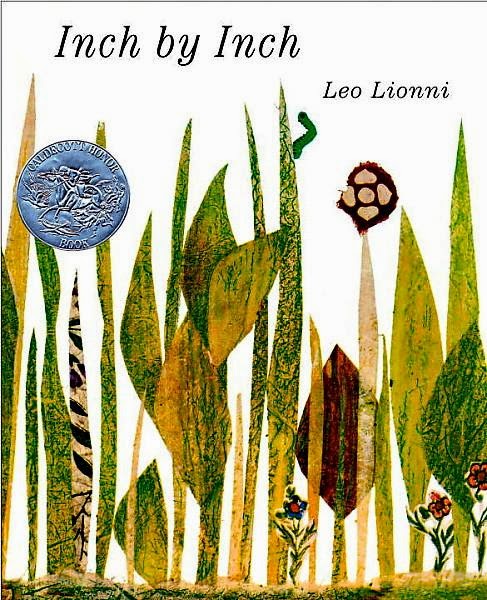
Inch by Inch is written by Leo Lionni. Leo Lionni will be the basis for my mentor work. Inch by Inch is a young children's book about an inchworm that is threatened to be eaten by a robin, but convinces the Robin that he has an amazing ability to measure things. The robin decides that the inchworm is acceptable when he measures his tail. The little inch worm proceeds to measure many different types of birds, all the way until the end of the book when the last bird wants him to measure his singing. When the inchworm is threatened to be eaten if he doesn't measure the bird's singing he then measures his singing by inching away.

This book is well written and great for younger children. The story is one that little children find humorous as the little inch is seen to be witty and cute inching away from the strong bird. It teaches children to find solutions to threatening problems. The book also teaches children that there are more than one way to do something. Learning to think on your feet is an important emphasis in the book.

The illustrations are appealing to the eye. The illustrations are clearly cut outs on a piece of white paper. They really make the pictures seem almost 3-D and lifelike. The pictures of the animals represent a true idea of what each of those animals look like in real life. The food chain is also resembled as a part of an idea in this book as the birds want to eat the inch worm.

Discussions could be brought up about the food chain. For example, is it really possible that a worm could convince a bird of something? Why or why not? Where did the inchworm get its name? What other foods do Robin's eat besides inch worms? You could also discuss issues such as critical thinking problems and responding to threats, how to handle them and what is the best way to do it.

Literary Elements:
Tone: Bright, cheery, bewilderment, puzzling
Setting: In the grasses and trees of some place
Characters: Intelligent, witty, smart, endearing, fierce, demanding

Lexile: 210L

Age Level: 4-7

Mini Lesson: Food chain and Bullying

Tuesday, January 13, 2015

Esperanza Rising

Ryan, P. M. (2000). Esperanza Rising. New York City, NY: Scholastic.


Esperanza Rising is a book about a girl living in Mexico who is forced to leave home after her father dies and her house burns down from a fire. There is a constant struggle as she moves to a new place where she is no longer considered rich. Esperanza has to learn to work as her mother gets sick and is put into a hospital. In the end, Esperanza learns how to be happier when Miguel brings her grandma to the United States to live with them.

The book is one of high quality literature in the fact that the book allows student's to walk in someone else's shoes. The book also draws student's in as Esperanza's struggles are similar to struggles they have to deal with in their daily lives. The book is stereotypical in the way it portray's Mexican's in America as being poor and having to work only in the fields. The book also is based off of the author's own personal experience which obviously leads to bias.

The girl in the story Esperanza seems to struggle with being content and happy. Despite her situations, she always is thinking about unrealistic expectations that later turn out differently then she expected. Esperanza is a delightful character in that she represents what seems to be most of the middle school population as they challenge ideas and authority and question life. Esperanza though she is a SUPER COMPLAINER! follows through with what she is asked of and doesn't resist despite her complaining. In a way, it teaches student's that we all go through bad times, but that doesn't mean you can back out of something just because it's difficult.

The book didn't have any illustrations, but the illustrations that seemed to arise from reading the book was that of a Mexican family living in a shanty hut, eating poor man's food and waiting to go work. The author's writings made the dirt come alive and the tastes and smells stick on each of the pages. Actually, sometimes, I wanted to put the book down because it seemed all too realistic, as if you were stepping into Esperanza's hard world. 

My reading buddy also read this book along with me; and she absolutely enjoyed it. She enjoyed the facts like Esperanza struggling to sweep and her journey to a new land. 

The age appropriateness of this book would be ages 9-13

Lexile Level: 750L 

Mini Lesson: I would use this book to have a discussion about "Have you ever had a situation where you had to leave somewhere you were comfortable to go to somewhere that made you uncomfortable? How did that make you feel? What was it like? How did the other people treat you? Were there things that contributed to making you feel comfortable/uncomfortable? How can we help others adjust to the United States if we know they are new here? 

Literary Elements: 
Tone: Uncomfortable, Complaining, Adventure, Sadness, Joy, Earthy
Setting: Rich Mexico, Poor United States
Characters: Array from young to old, Mexican's- hard working, caring for families, love, appreciation, heritage

Monday, January 12, 2015

When Will It Snow?


White, K. (n.d.). When Will It Snow? N.p.: Little Tiger Press

When Will It Snow is a book about a baby bear who is longing to stay awake during hibernation so he can see the changes of winter; however; his momma bear will not allow him to stay awake during the winter. Bears friends squirrel and mole tell baby bear all about the sights and sounds of winter.  In the end, bear is happy because he gets to meet up with his friends again in the Spring, and they were true friends to him.

The book is very appealing to children. The images are very lively and have very beautifully painted scenes. The expressions shown on the characters faces are all revealing to the situation which help the children understand how the characters are feeling emotionally when different situations arise. The conflict presented in the story is that the bear wants to stay awake for hibernation, a time when bears do not stay awake for. Bear is also sad because his friends get to stay awake and play and he does not, and bear is scared that they will not be there for him when he gets back. The conflict is resolved when bear’s mother teaches him that true friends will be there for you. In Spring, his friends are still there for him and they have fun playing in the Spring time together.

The story offers many different things to consider including what are true friends, why do bears have to hibernate during the winter, how can you simulate snow in the spring and much more. The discussions that can open from this book are ranging from discussions about friendships and science.  The settings involved are depicted realistically regarding the different changes of seasons. Obviously, the animals are not realistically represented as their faces are shown smiling or frowning, and bears do not stand upright all the time, however, the actual body shape of the animals are accurate to their description.

The stories can promote diversity as all of the characters in the book are different and have different needs. The story promotes unity and friendship among the differences.

Age Level: 4-7


Lexile Level: Not Listed

Luke On The Loose


Bliss, H. (n.d.). Luke On The Loose. N.p.: Toon Books.

This book was shared with lots of laughs with my reading buddy. My reading buddy was giggling excitedly through almost every page of the book. My reading buddy really liked the illustrations involved in the graphic novel. The pages are exciting and exhilaration. I believe the pictures on the page are both shocking and funny as Luke runs throughout the town chasing a group of pigeons causing accidents and distresses everywhere. In the end Luke is put on a little leash showing a result of what will happen if you run away. The book really is a comical graphic novel.
The conflict presented is that Luke is bored talking with his dad and then he gets distracted with the group of pigeons. The conflict is resolved when Luke gets tired and sleeps on a roof and his dad and the police men also rescue Luke.

This book is a great book to get student's excited about reading. The pages are illustrated in a format that makes it very appealing. The comical drawings make the reader fall easily into the pages. I would recommend this book for a pair-to-share event. Student's can then make their own comic book events about a situation they can relate to. 

Diverse populations of both Caucasian, Hispanic, African-American. The illustrations depict both young and old folks.

The stories have the potential of some discussions, for example the benefits or disadvantages to following rules, consequences for actions, and perhaps the dynamics of parent-child relationships. The stories are certainly age appropriate and very appealing to children of about eleven years old.

Age Level: 9-13


Lexile Level: GN170L